By Judy Blumenfeld, MFT, Psychoanalyst
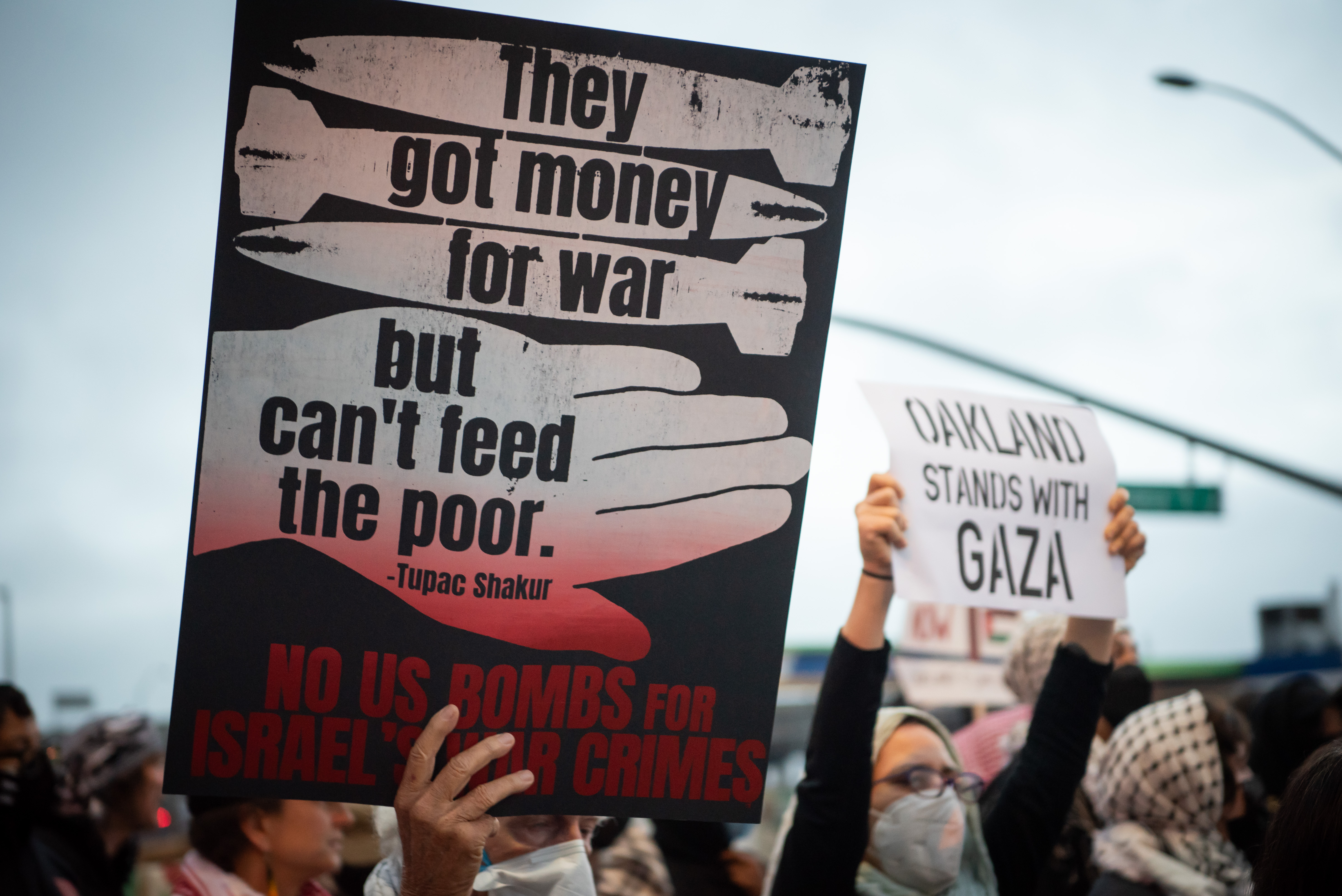
This is an attempt to integrate parts of me that can become split off. My effort to remain whole; to stay present to a genocide, to fascism, to this moment. I cannot use psychoanalysis only to attempt some kind of personal happiness or to assist patients in understanding their symptoms or how to live with and recognize feelings. How do we also stay present to the truths of death cults, concentration camps, forced starvation, and the robbery of the very thinnest safeties, which feeds the rapacious corporate elites?
To be a psychoanalyst and an activist is to speak plainly and simply when necessary. I recently attended a poetry reading. It was a benefit for a 35-year-old Palestinian solidarity organization. The poet quoted the late revolutionary poet, June Jordan, who told students, “you are the news.” To hold this idea that the students creating communities of resistance in the encampments, demanding freedom for Palestine are the news and that the ones who are committed to justice are the news is hopeful and empowering. Engagement with these students, solidarity with their principled stance in relationship to genocide, and resistance to their marginalization are all examples of psychoanalytic activism. These are all acts that continually see and respond to realities that forces of oppression seek to render invisible and unthinkable. What we say and what we do not say locates us as activists in our field.
The poet was a professor at a university but named herself as co-learner. A psychoanalytic activism can include the word “co” as in collaborate, as in name together as in co-constructed. This is a way to be in-relationship.
You are the news – a mirroring response to young people affirming their ability and right to take power, to take a stand. A resistance to the hijacking of truth, the omissions of truth, and the lies of the mainstream media; live streamed genocide named by some and ignored by others – including psychoanalytic institutions.
To be a psychoanalytic activist; how is it different from being an activist? It could mean we organize where we are. We are in institutes and organizations, we are with our patients, and we are in community mental health organizations. We work in the non-profit industrial complex – the same corporatized nonprofits that are being dismantled by a fascist regime as I write this. Our ability to care for each other is under attack. Our ability to name racism, classism, genocide and anti-queer and transphobic violence, to take positions in support of movements that work, and fight for social change makes us psychoanalytic activists.
I have been an activist for longer than I have been a psychoanalyst, and the wedding of the two has been challenging. In our field, we seem to be uneasy with strongly naming differences, disagreements, and wrongdoing. We worry about splits rather than centering solidarity. We look for commonalities in our effort not to split. The idea of dialogue has been used to impose liberal colonial conditions on Palestinians who are fighting for their land and, now, against a genocide. Dialogue that softens disagreement rather than producing material change leaves oppressive systems intact. It posits that if people can understand the “other,” all can be better. Psychoanalysis seems to love dialogue. Both-sidism, we have come to call it. I think being a psychoanalytic activist requires a willingness to take a side.
What do we do as fascism has taken hold? Do we look away as activists and immigrants are disappeared? Do we name a genocide? Do we fear retaliation or move away from standing up, in the fear of offending or being accused of sin in psychoanalysis; the sin of not listening, the sin of not engaging with the other – when the other wants to murder our Palestinian siblings or kill transgender children?
During the first Trump presidency, I heard much talk in psychoanalytic institutes and circles about “recognizing the Trump in all of us.” I would posit that perhaps it is acceptable and helpful to identify an enemy. It may raise our fur to use the word “correct,” yet, there is meaning and necessity to stand on the “correct” side of history and to correct history. Campaigns for land back, reparation, decolonization are attempts to repair and correct history. This does not mean that we do not examine the conditions that we were raised in and with, and how those conditions, privileges, and realities shape us – including the unconscious dynamics of harm. We can reflect while also standing in opposition.
We fight back. We stand together. We do not look away. Being a psychoanalytic activist means we center our relationships, and we speak the unspoken.
What does it mean to be a radical rather than a liberal? For me what attracted me to psychoanalysis was depth. There is a shallowness to liberalism and the danger of it never disrupting anything. It tries perhaps to cure a symptom rather than go deeply into, to interrogate and change a system. It maintains a system rather than disrupting it.
Ultimately, it colludes with fascism. There are historical examples of this. The social democrats in fascist Germany joined with the Nazis against the “common enemy” of socialism. And, today, the Democratic party actively brags about their role in increasing funding for the violent, carceral institutions of surveillance and disappearance embodied in ICE and its affiliates.
To be a psychoanalytic activist is to take up contradictions, educate or co-learn.
In being engaged in the urgency of justice we work to facilitate a change in people’s minds.
To be a psychoanalytic activist is to be deeply committed to structural change, to be a radical, to be interested in more than reforming something that, at its core, is built on colonization.
Writing is beautiful and helpful. It grounds us, and it is not enough; not enough as psychoanalysts or as activists. Reading collectively the radical traditions and theories, the writers and cannons from liberatory praxis, the poetry of revolution and liberation, can help ground and inspire us in our work. Let’s move beyond reading and writing towards collective mobilization and away from a false meritocracy that has a stymying hold on our learning institutes and academic spaces.
Zionism in psychoanalysis is a topic close to my heart. It was the transgenerational transmission of trauma in my own family (grandparents and almost all family members murdered in Auschwitz) that, in part, formed and deepened my commitment to social justice activism and firmly rooted me as an anti-zionist. To be a Jewish person and activist within psychoanalysis, I find my ability to challenge Zionism central. It seems to be a “fact” in many circles that there are two sides to something. Being a psychoanalytic activist means disrupting this idea. The liberalism that saturates our field is used to theorize and reify a both-sidism, rather than as a condemnation of racism, genocide, and transphobia. I think being a psychoanalytic activist also has to do with making new theory that disrupts theories that are used to create openness and false equivalence when condemnation and solidarity is necessary.
Recently at a paper presentation that touched on transgenerational trauma, an analyst commented during the discussion, “I could not listen to the German language for many years.” In response, I said that I am struggling to listen to the language of my religion and childhood prayers as it has been stolen by Zionism to create an ethnostate. It is the language of the last words that Palestinian children hear before they are murdered. It is the language that withholds food and forces starvation.
Being a psychoanalytic activist in this moment requires disruption and also a connection between experiences. The disruption of certain narratives is part of being a psychoanalytic activist, and is vital to the act of accompanying others as they begin to disentangle and disrupt narratives that defend empire, white supremacy, and colonialism.
As Mumia Abu Jamal, an internationally celebrated black writer, radio journalist and revolutionary who has spent the last 30 years in prison – almost entirely in solitary confinement on Pennsylvania’s death row – says:
“The greatest form of sanity that anyone can exercise is to resist that force that is trying to repress, oppress, and fight down the human spirit.”
 The Psychoanalytic Activist